
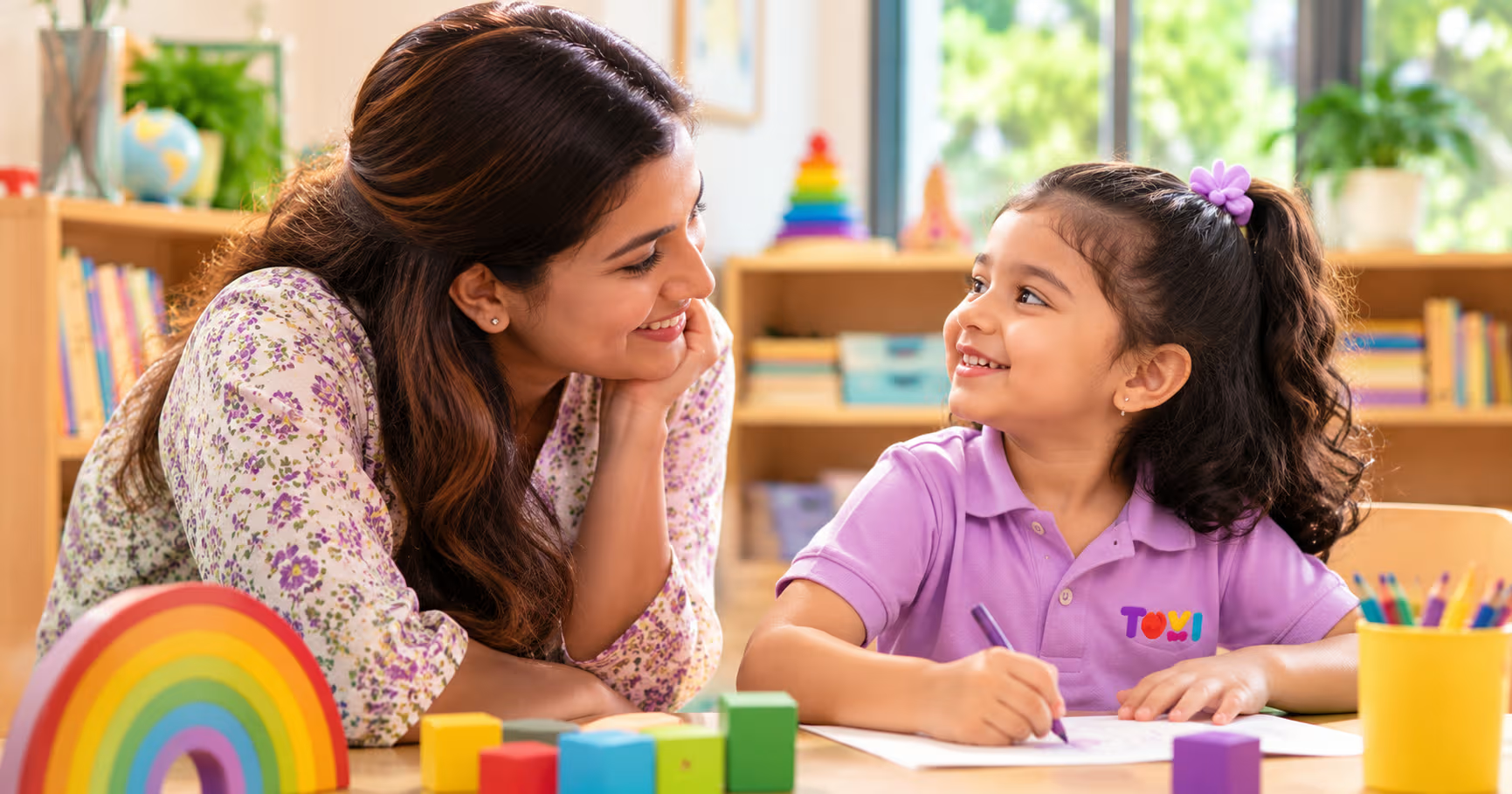
Every admission season, we hear the same question. Sometimes at the school gate. Sometimes in a WhatsApp message at 10 pm.
“Is my child ready for preschool?”
For many parents, this is a big step. Their toddler may be spending a few hours away from home, with people who aren’t family, for the very first time.
At Tovi International Preschool in Magarpatta, Pune, our educators have welcomed children who walk straight towards the toys on their first day and others who hold tightly to their parent’s hand. Some settle quickly. Others need more time, familiar routines and plenty of reassurance.
So, how do you know when your child is ready?
Here are seven signs we look for, along with what matters less than parents sometimes think. You don’t need seven perfect answers to make a decision.
Key takeaways
- Preschool readiness depends on the child, not just their age.
- Children don’t need to show all seven signs before starting Playgroup.
- Crying at drop-off is common. How your child responds to comfort matters more than whether they cry.
- Knowing the alphabet, holding a pencil correctly and speaking in full sentences aren’t requirements for Playgroup.
- Familiar routines and short, predictable separations can help children adjust.
- If you’re unsure, visit the preschool with your child and speak with the educators.
Playgroup, Nursery and preschool: what’s the difference?
Parents often use these words interchangeably, but they refer to different stages of early learning.
Playgroup is usually a child’s first experience in a group setting. Children spend time playing, listening to stories, moving, exploring materials and becoming familiar with other children and adults.
Nursery generally begins around three years of age. Children continue learning through play, with more opportunities for guided activities and participation in group routines.
At Tovi, Playgroup is designed for children aged 2 to 3 years, while Nursery is for ages 3 to 4.
The National Education Policy 2020 identifies ages 3 to 8 as the Foundational Stage, covering three years of preschool followed by Classes 1 and 2. The approach emphasises play, activities, exploration and age-appropriate learning.
What is the preschool admission age in Maharashtra?
Maharashtra revised its school admission-age requirements on 15 October 2026.
Under the new rules, children entering Nursery from the 2027–28 academic year must complete three years of age by 30 June of the admission year.
The remaining age requirements will be introduced in phases:
| Programme | Minimum age | Effective academic year |
|---|---|---|
| Nursery | 3 years | 2027–28 |
| Junior KG | 4 years | 2028–29 |
| Senior KG | 5 years | 2029–30 |
| Class 1 | 6 years | 2030–31 |
The government resolution also includes transitional provisions for existing students and permits a limited 15-day age relaxation at the school-head level.
Parents should confirm the applicable admission criteria with their chosen school.
Source: Government of Maharashtra, School Education Department, 15 October 2026.
If you’re deciding whether to enrol your toddler now or wait a little longer, our guide to the right age to start preschool explains the different stages in more detail.
Age is a starting point, not the answer
Two children of the same age can be very different.
One two-and-a-half-year-old walks in, finds the toy kitchen and starts playing. Another, the same age, holds on to mum’s dupatta for twenty minutes.
Neither response tells you everything about that child’s readiness.
We have seen children who need several difficult mornings before they begin to feel comfortable.
One of our educators remembers a boy who cried at drop-off for nine mornings. On the tenth, he walked in holding the classroom teddy and said, “I want to hear a lion story today.”
He had needed those nine days.
That is why we look at how a child responds to the environment over time rather than judging their readiness from the first morning.
The 7 signs your child is ready for preschool
1. Your child can cope when you’re not there
We don’t mean that your child never cries.
Think about how they behave with a grandparent, an aunt or another adult they know well. Do they cry when you leave but eventually settle? Can someone else comfort them?
That recovery is an encouraging sign.
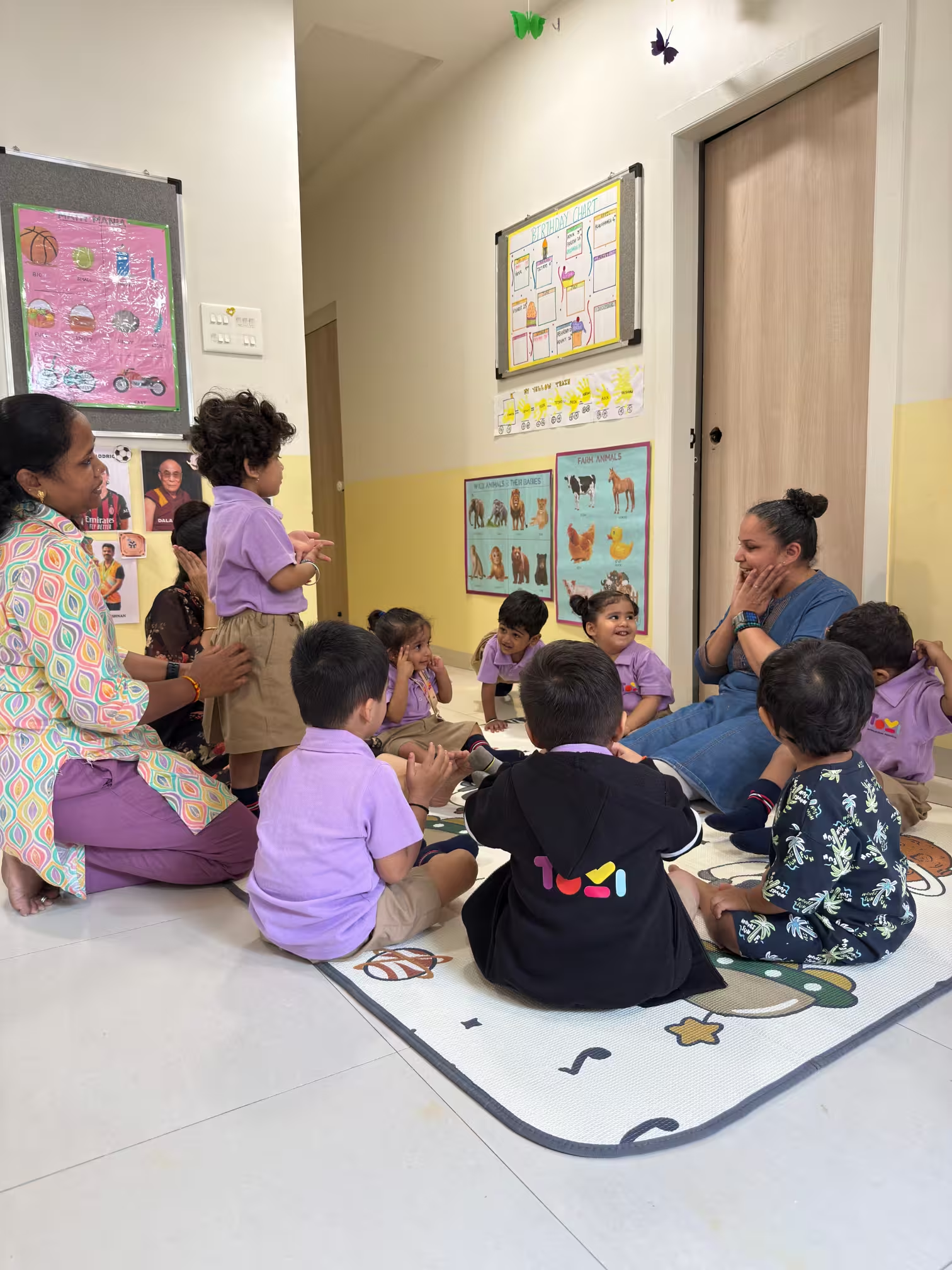
A few tears at drop-off are normal. Crying that continues for long periods without improvement, however, deserves attention.
Separation anxiety is common in early childhood. The American Academy of Pediatrics explains that it often peaks between 10 and 18 months and may continue into the toddler years. A new environment, including preschool, can make separation difficult again.
The American Academy of Pediatrics’ guidance on childcare drop-offs recommends familiar routines and brief, predictable goodbyes.
At home, try leaving your toddler with someone they trust for a short period. Tell them you’re going, explain that you’ll return and keep your promise.
You can start with a few minutes and gradually increase the time.
If separation distress is severe, persistent or affecting your child’s everyday life, speak with your paediatrician.
2. They notice other children
Your toddler doesn’t have to share every toy or join every game.
But do they watch other children at the park? Go near them? Copy something another child is doing?
At this age, children often play next to each other rather than directly with each other. Teachers call this parallel play.
You might see two toddlers sitting side by side, each building their own tower. They aren’t necessarily playing together, but they’re noticing each other’s actions.
That’s a normal part of early social development.
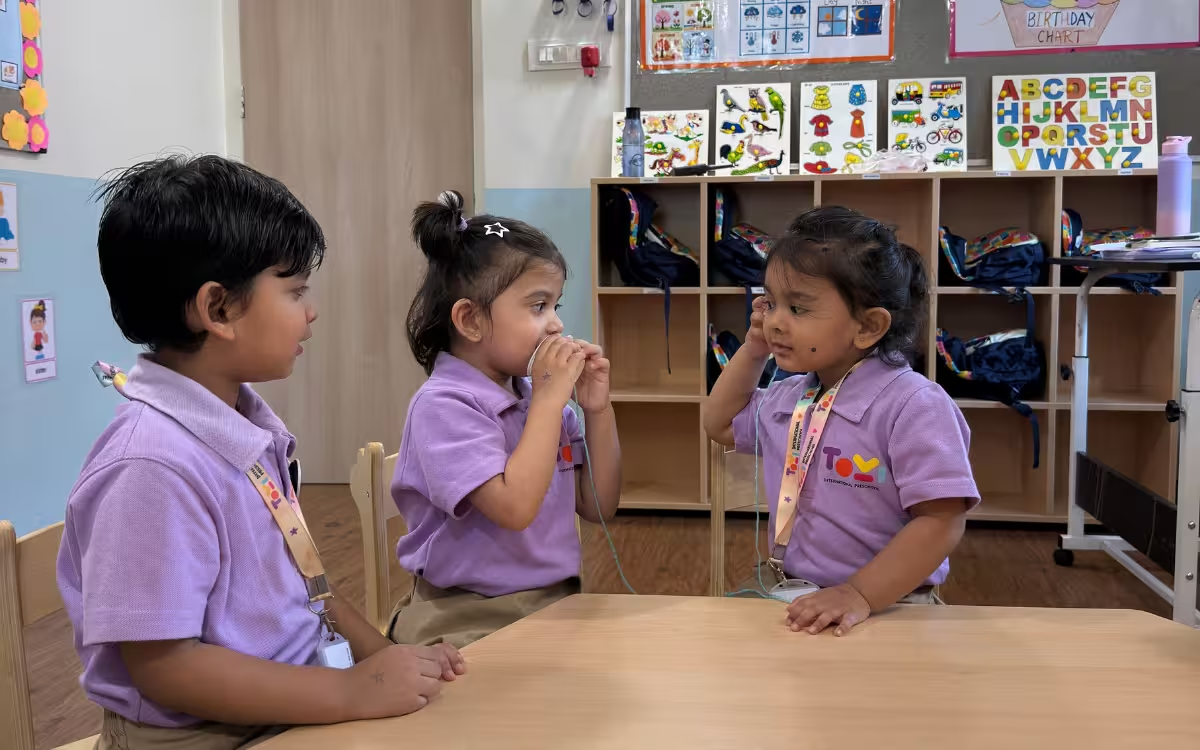
At Tovi, Playgroup gives children opportunities to become familiar with other children through activities, songs, movement and everyday play.
Some children join in immediately. Others watch from a little distance before they feel comfortable participating.
You can learn more about these experiences on our Playgroup programme page.
3. They can show or tell you what they need
Words are useful, but pointing, pulling your hand, making a sound or using a gesture counts too.
What matters is that your child has some way to communicate basic needs.
They might say “paani” when they’re thirsty, point to their bottle or take an adult towards something they want.
Parents often understand their child’s own words and gestures better than anyone else.
At Tovi, we ask parents about these familiar expressions when a child first joins us.
One child might call their bottle “pa”, while another uses “moo” for a favourite cow toy. These little details help educators understand what a child is asking for.
You don’t need to teach your toddler English phrases before preschool. Encourage them to communicate in the language they use naturally at home.
If your child has very limited communication for their age, or you’re worried about their speech or hearing, please speak with your paediatrician. Don’t wait for school to resolve a possible developmental concern.
4. They can follow simple instructions
“Come here.”
“Put the toy in the basket.”
“Let’s wash our hands.”
If your child understands familiar instructions most of the time, they’ll have a useful starting point for classroom routines.
That doesn’t mean they will always listen.
A toddler who is busy with a favourite toy may ignore a request even when they understand it perfectly well.
Try asking your child to bring their shoes or put a book on the shelf. Do they understand what you’re asking and make an attempt?
Following two instructions in sequence, such as picking up a bag and then sitting down, is helpful. It isn’t something every child must manage before Playgroup.
Teachers expect to repeat instructions and help children through daily routines.
5. They can stay with an activity for a few minutes
For a toddler, a few minutes can be plenty.
Can your child look at a picture book with you, stack blocks or scribble for three to five minutes?
That’s an encouraging sign.
Nobody should expect a two-year-old to sit still for half an hour.
At Tovi, circle time is approximately ten minutes. Children who move away from the group can return when they’re ready. Our educators understand that young children are still developing the ability to participate in group activities.
Pretend play is useful here too.
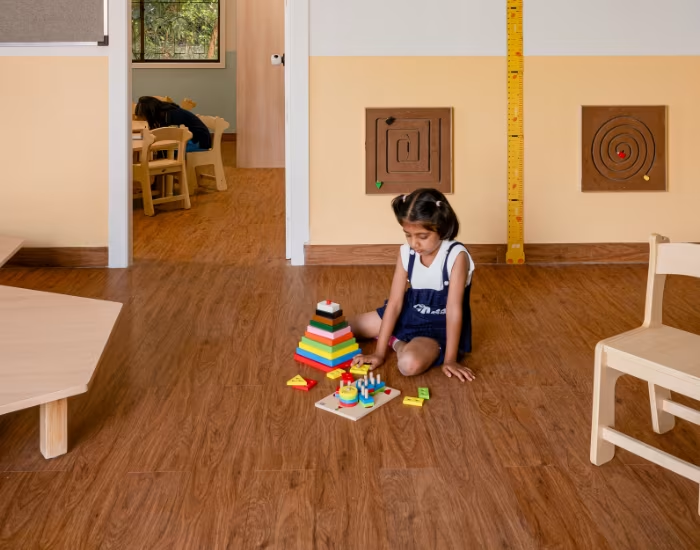
A child feeding a doll, pretending to cook or running a toy shop is using imagination while practising everyday language and interactions.
Research suggests that pretend play can be associated with aspects of attention and self-regulation. In one study involving 60 three-year-olds, children who engaged in story-related pretend play performed better on a measure of inhibitory control than children who completed a non-pretend activity.
The results concern a specific activity and group of children. They don’t mean pretend play will automatically improve every toddler’s attention.
For parents, the practical point is simple: give your child opportunities to play, imagine and explore. Sitting quietly isn’t the only way children learn to concentrate.
6. They have a basic routine and enough energy for the day
Does your child have reasonably regular meal, sleep and wake-up times?
Children who are familiar with a daily rhythm may find it easier to adjust to preschool because school has its own routine too.
Naps matter.
A morning programme can be tiring for a toddler who still needs a long nap at that time or regularly wakes up tired.
According to sleep recommendations supported by the American Academy of Pediatrics:
| Age group | Recommended sleep in 24 hours |
|---|---|
| 1–2 years | 11–14 hours, including naps |
| 3–5 years | 10–13 hours, including naps |
You can read the AAP’s guidance on healthy sleep habits for children.
Many toddlers move towards a single daytime nap during their second year, although individual sleep needs vary.
If your child still needs a long morning sleep, discuss programme timings with the preschool rather than suddenly changing their entire routine.
Our educators often notice when a child arrives tired or has skipped breakfast.
We tell parents that an earlier bedtime and a proper breakfast can be more useful preparation for school than another round of alphabet practice.
7. They show a little independence
Can your child hold their cup? Try feeding themselves, even messily? Attempt to take off their shoes? Walk towards a toy and pick it up?
These are small signs of growing independence.
A toddler doesn’t have to do everything alone. They just need opportunities to try.
Teachers can help children practise everyday tasks, from putting away toys to washing their hands.
At home, let your child carry their small bag or put their books back on a shelf. Give them time to finish, even if helping would be quicker.
Some tasks will be easy. Others will take weeks of practice.
That’s part of early childhood.
What about potty training?
This is one of the biggest worries parents have before Playgroup.
Many children around two years old are still learning to recognise when they need the toilet. Some use diapers or pull-ups, while others are beginning toilet training.
Expectations vary between preschools.
For Nursery, where children are generally older, schools may expect greater independence with toileting. Occasional accidents can still happen.
Before admission, ask the preschool how it supports children who are toilet training, whether changing facilities are available and what spare clothing parents should send.
If your child uses particular words or gestures to communicate toileting needs, share those with the educators.
Toilet training should be handled patiently. A child should never be embarrassed about having an accident.
What does not matter yet
Many parents worry about the wrong things.
A child starting Playgroup doesn’t need to:
- Know the alphabet or count to 100.
- Hold a pencil correctly.
- Write letters or numbers.
- Speak in complete sentences.
- Speak English when another language is used at home.
- Share every toy without getting upset.
- Sit quietly for long periods.
Children develop early language, numeracy, social and physical skills through play, songs, stories, movement and everyday experiences.
This approach is consistent with the National Curriculum Framework for the Foundational Stage (2022), which places play-based learning at the centre of early childhood education.
There is research behind the value of play, too.
In a 2019 study, Esin Sezgin and Serap Demiriz examined a structured play-based programme involving 54 children aged 48 to 60 months. Children in the intervention group showed significantly better behavioural self-regulation scores than those in the comparison group.
Behavioural self-regulation involves abilities such as listening, managing impulses and following instructions.
The study involved four- and five-year-olds, so its results shouldn’t be directly applied to two-year-olds entering Playgroup. It does, however, add to the evidence supporting developmentally appropriate play in early education.
You don’t need to fill your toddler’s afternoons with writing worksheets or flashcards. There is plenty to learn through play.
When it might be better to wait
A short wait isn’t a failure.
It may be worth discussing a later start or a more gradual introduction if:
- Your child becomes extremely upset during short separations and doesn’t respond to comfort.
- They seem consistently frightened or overwhelmed in unfamiliar group settings.
- Their current sleep routine makes the proposed school hours difficult.
- You’re considering admission mainly because relatives or other parents say you should start now.
That last situation is common. Admission season brings plenty of pressure.
But a child who starts a little later and feels comfortable may find the transition easier than a child who begins before they’re ready for the experience.
If you’re worried about your child’s communication, hearing, behaviour or development, don’t rely on waiting alone. A paediatrician can help you decide whether any additional support is needed.
Some families also need childcare because a parent is returning to work. That is a practical consideration, and it deserves an open conversation with the school.
If that’s your situation, tell the educators about your child’s routines and separation difficulties so you can discuss how to help them adjust.
How to get your toddler ready without turning it into a project
You don’t need flashcards or a special school-readiness timetable.
Try a few simple things over the weeks before preschool begins.
- Practise short goodbyes. Leave your child with a trusted relative for a manageable period. Say goodbye, explain when you’ll return and follow through.
- Visit the preschool together. Look around the classroom, see the toys and meet the educator. If possible, let your child become familiar with the setting before their first day.
- Spend time around other children. A park, a cousin or a neighbour’s child is enough. Even fifteen minutes can give your toddler an opportunity to watch and interact.
- Keep a steady routine. Try to maintain reasonably consistent sleep, meal and wake-up times.
- Talk about school simply. You could say, “You’ll play with toys and sing songs. Then I’ll come and pick you up.”
- Let them try small tasks. Putting toys away, washing hands with help and carrying a small bag can build confidence.
- Never sneak away. It may seem easier to slip out while your child is distracted, but a short, predictable goodbye helps them understand that you leave and return.
A tip from our educators
Long goodbyes can make separation more difficult.
Try keeping yours warm, brief and consistent. If your child is upset, let the educator know what usually helps them settle.
Sometimes we suggest that parents send a familiar item from home, such as a favourite toy or blanket, when appropriate.
We also have a comfort box in the classroom for children who need a little reassurance.
For some toddlers, holding something familiar makes the first few mornings easier.
What the first few weeks of preschool usually look like
Every child settles differently, but our educators often see certain patterns.
Week 1: Getting used to the new surroundings
Some children cry at drop-off. Others remain quiet and watch what is happening.
A child who seems happy on day one may become upset on day three, once they realise that school is going to be part of their regular routine.
This can surprise parents.
At Tovi, we help children become familiar with the classroom and educators gradually. During the initial settling-in period, parents can remain on campus in the Parent Hub.
Where a child needs additional support, shorter initial sessions can be discussed before moving towards the regular programme.
Weeks 2 to 4: Familiar faces and routines
Many children begin recognising their educators and approaching activities they’ve enjoyed before.
They may still cry at drop-off, but settle more quickly once they’re inside.
You might also hear your child mention a song, a toy or another child when they get home.
After the first month
Some children are excited to arrive at school. Others still need encouragement and reassurance.
We’ve seen children who settle within the first two weeks and others who take considerably longer.
There is no single deadline by which every child should feel comfortable.
If your child remains highly distressed, or things aren’t improving, speak with the educators about what they are observing during the day.
A conversation about your child’s actual experience is more useful than comparing them with another child who settled sooner.
Is my child ready for preschool? A quick checklist
Answer each question with Yes, Sometimes or Not yet.
| Question | Your answer |
|---|---|
| Can my child spend some time with another trusted adult? | Yes / Sometimes / Not yet |
| Do they watch or play near other children? | Yes / Sometimes / Not yet |
| Can they show or tell someone what they need? | Yes / Sometimes / Not yet |
| Do they understand simple instructions? | Yes / Sometimes / Not yet |
| Can they enjoy an activity for a few minutes? | Yes / Sometimes / Not yet |
| Do they have a fairly steady daily routine? | Yes / Sometimes / Not yet |
| Do they try small everyday tasks themselves? | Yes / Sometimes / Not yet |
Mostly Yes or Sometimes?
Your child may be ready to explore Playgroup, particularly if the school offers a supportive settling-in process.
Several Not yet answers?
Look at which situations are difficult for your child. You might practise one or two skills at home, discuss their needs with the preschool and reconsider after a little time.
There is no minimum score. This checklist helps you observe your child; it isn’t a developmental test or a guarantee that they will settle easily.
Questions parents often ask
Is a three-year-old ready for preschool?
Many three-year-olds are ready for Nursery, but age doesn’t tell you everything. Some children are comfortable with group activities and separation, while others need additional support. Look at how your child communicates, follows familiar routines and responds to unfamiliar adults.
What is the age for Nursery admission in Maharashtra?
From the 2027–28 academic year, children must generally complete three years by 30 June of the admission year under Maharashtra’s revised admission rules. The resolution also provides transitional arrangements and a limited relaxation provision. Confirm eligibility with your chosen school.
How do I know if my child is ready for Nursery?
Children entering Nursery may be more familiar with group routines, simple instructions, basic communication and everyday self-help tasks. However, schools differ in their expectations. Speak with the educators about your child’s needs before deciding.
How long does it take for a child to adjust to preschool?
Some children settle within a few days, while others need several weeks. The important thing is whether they’re gradually accepting comfort, becoming familiar with their educators and participating in activities. If distress remains severe or persistent, discuss it with the school and your paediatrician.
Is Playgroup the same as preschool?
Playgroup is usually an introductory programme for younger toddlers, with an emphasis on play and becoming familiar with a group environment. Nursery and kindergarten programmes generally introduce more structured activities as children grow. Playgroup is not a compulsory prerequisite for Nursery.
Does my child need to be potty-trained before preschool?
That depends on the child’s age and the preschool’s policy. Many young toddlers are still toilet training. Ask the school about its expectations and the support available before admission.
Should we start at the earliest age the school allows?
Not necessarily. The minimum admission age tells you when a child becomes eligible, not whether that is the best starting point for every family.
Consider your child’s readiness, daily routine and the support available at the preschool before deciding.
One last thing
If you’re standing at the school gate wondering whether you’re doing the right thing, you’re probably paying close attention to your child.
That’s a good place to begin.
Some children walk into Playgroup without looking back. Others need a familiar toy, a patient educator and a few difficult mornings before they start feeling comfortable.
Watch how your child responds to new people. Notice the small changes. Ask questions when something concerns you.
And if you’re unsure, talk to the people who will be looking after them.
You don’t have to figure everything out before the first day.
This article provides general guidance for parents. It is not medical advice. If you’re concerned about your child’s speech, hearing, behaviour or development, please speak with your paediatrician.
Tovi International Preschool · Magarpatta
Come see Tovi for yourself.
Explore our Playgroup classrooms, meet our educators and see how we help little ones settle into preschool.