
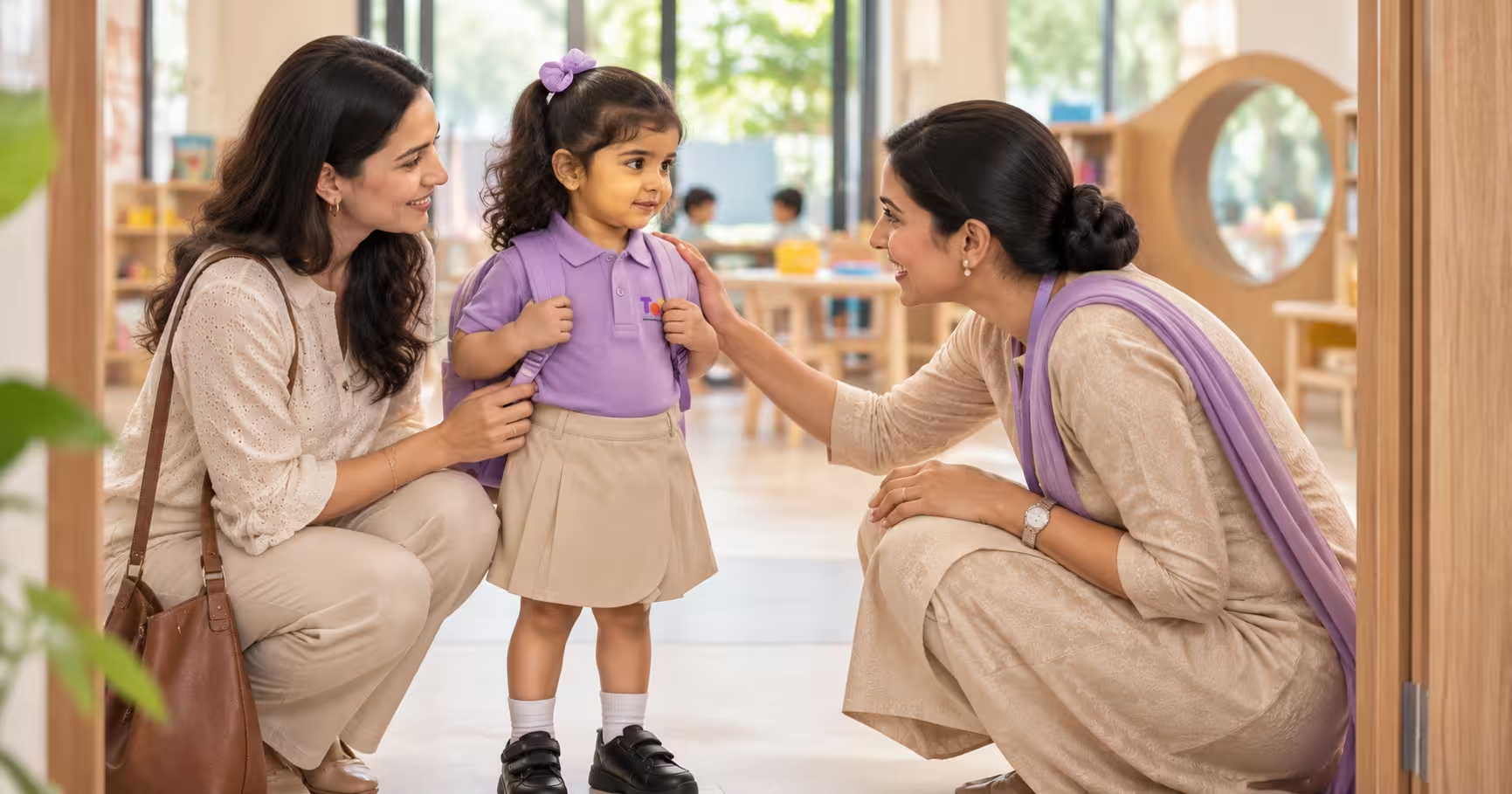
It is 10 pm. The bag is packed. The water bottle has a name on it. And you are lying awake wondering what tomorrow will look like.
If you are nervous about your child’s first day of preschool, you are in good company. We see it in parents every year. Some hide it well. Some cry at the gate before their child does.
At Tovi International Preschool in Pune, we have welcomed many children on their first day over our years of teaching toddlers. There have been tears on plenty of those mornings. Some were the children’s. Quite a few were the parents’.
Here is the short answer. On the first day, your child will mostly look around, play, meet the teacher and start to learn the routine. Nobody expects much more. Some children settle quickly, while others need weeks. Both are normal.
The rest of this guide covers what happens, how to prepare, what to do at drop-off, and what to do if your child cries.
Key takeaways
- The first day is about getting familiar, not about learning anything specific. Watching from the side counts.
- Tears are common, but not every child cries. Crying does not mean the school is wrong or your child is not ready.
- A short, warm, predictable goodbye is usually better than a long one.
- Never sneak away. Say goodbye, even if it is hard.
- Settling in takes days or weeks, and progress can go up and down.
- Talk to the teacher. You are on the same team.
What to expect on your child’s first day of preschool
Every school runs a little differently, so treat this as an example, not a rule. Here is the usual order.
- Arrival and drop-off. A teacher greets your child, often by name. Your child puts their bag and bottle away, with help if needed, and says goodbye to you.
- Getting comfortable. Children explore toys, books and corners of the room. Many just stand and watch for a while. That is fine.
- Meeting the teacher and other children. Some children join in on day one, while others prefer to watch for a few days. Both are okay.
- Play and simple activities. Songs, picture books, sand, colours, blocks, movement. Nothing is graded.
- Snack, washing hands and toilet time. Teachers help with all of these.
- Pick-up. You reconnect, and the teacher tells you how the day went.
What does the first day look like at Tovi?
At our Playgroup, we greet each child at the door at their eye level. We give them time to explore the classroom and become comfortable with the surroundings before encouraging them to join activities.
Familiar songs, play and snack time help children begin to understand the routine.
The first day may be shorter or follow a different routine from a regular school day, depending on the preschool’s settling-in arrangements. Ask your child’s school what to expect during the first few sessions.
How to prepare your child for the first day of preschool
You do not need flashcards or a big plan. A few small things done over a week or two are enough.
A week or two before
- Talk about school in a simple, happy way. “You will play with toys and sing songs. Then we will come and pick you up.”
- Read a story about starting school. A picture book can make the idea less strange.
- Visit the school together. Walk in, look around, meet the teacher, leave. A short visit can help your child become familiar with the place.
- Practise short goodbyes. Leave your child with a grandparent or someone they trust for a short while. Say goodbye, tell them when you will be back, and come back on time.
Small habits that help
- Fix the routine. Try to get sleep, meals and wake-up times close to the school day, a little at a time.
- Let them try small things. Washing hands, putting a toy in a basket, carrying their own bag, asking for water.
- Practise the goodbye words. “Bye-bye, I’ll be back after school.”
Your child does not need to be perfect at any of these because teachers expect to help.
If you’re still wondering whether your child is ready for this step, our guide to the signs your child is ready for preschool may help you understand what to look for.
Did you know?
Separation anxiety is a normal stage of development. The American Academy of Pediatrics says it usually peaks between 10 and 18 months and most often fades by around age 2, though some children take until about age 3. It can also come back in new situations, like starting school. That is why a tearful first day does not mean something is wrong.
If I could ask every parent to do one thing, it would be this: practise the goodbye at home. Leave the room, say “Bye, back soon,” and come back. Children gradually learn that you always return.
First day of preschool checklist for parents
Tick these off the night before.
- A change of clothes
- A school bag with your child’s name on it
- A labelled water bottle
- A snack or tiffin box, unless meals are provided by the school
- Diapers and changing supplies, if your child needs them
- Any medicine or allergy information, shared with the school according to its rules
- Emergency contact details and any forms the school has asked for
- A clear idea of drop-off and pick-up times and who will collect your child
- Any photographs or documents specifically requested by the school
Ask the school what needs to be packed each day. Some preschools provide certain supplies or have specific rules about food, medication and belongings.
What should you do at drop-off?
This is the part parents worry about most. Here is what works.
- Arrive a little early. A rushed goodbye makes everyone more anxious.
- Follow the teacher’s lead. Hand over your child the way the school has explained.
- Name the feeling. “It’s okay to feel a bit worried.”
- Say a short, warm goodbye. “I love you. I’ll be back after school.”
- Leave when you said you would. Do not slip out while your child is busy or keep going back after saying goodbye. Both can make the separation harder.
- Ask how you will hear from the teacher. Find out how the school communicates with parents and when you can expect an update.
Quick tip
Long goodbyes make separation harder. If you linger, the anxiety lingers too. A short, warm goodbye works better than hanging around. This matches the advice summarised from the American Academy of Pediatrics.
Should you stay in the classroom?
It depends on the school. Some let parents wait nearby for the first few days. Others ask parents to leave after the handover because that works better for their settling-in process.
Ask what your school does, and follow it.
At Tovi, parents can remain on campus and use our Parent Hub during the initial few days while their child becomes familiar with the teachers, classroom and daily routine.
As children become more comfortable, parents can gradually step back. We want the transition to happen at a pace that takes the child’s needs into account.
What if your child cries on the first day of preschool?
Many children do. Some cry loudly, while others go quiet. A few do not cry at all.
Here is what I want you to know. Crying does not necessarily mean you made a bad choice or that the school is not right. It may simply mean your child is finding something new and unfamiliar difficult.
What helps
- Stay calm. Children notice your face and voice. If you look frightened, they may feel more worried.
- Name the feeling. “You are sad. That’s okay. Your teacher will help you.”
- Trust the handover. Teachers can offer comfort and a familiar next step, like a toy or a song.
- Do not promise it won’t be upsetting. Promise that you will be back.
Words you can use: “It’s okay to feel unsure. Your teacher will help you, and I’ll come back after school.”
When a child cries at the door, I kneel down, say the child’s name and tell them I am here. Then I pick up a toy and say, “Come, let’s feed the doll.”
Sometimes the child begins playing with me. Sometimes they need more time or simply want to stay close to a familiar adult.
We never force a child to stop crying.
What if it still does not get easier?
Talk to the teacher. Share what you see at home, and ask what the teacher sees in class.
Together, you can work out whether your child needs a slower settling-in process, a more predictable morning routine or some extra support.
If the distress is severe, gets worse or continues for many weeks, speak to your paediatrician as well. You don’t need to wait that long to seek advice if you’re concerned.
What activities will your child do?
Nothing fancy. The first day is gentle on purpose.
At Tovi, our approach to curriculum and learning combines purposeful play, hands-on experiences and age-appropriate guidance.
Play-based learning is also the approach India’s education framework recommends for the early years. NEP 2020 and the National Curriculum Framework for the Foundational Stage (2022) place play, activity and exploration at the centre of early childhood education.
| Activity | Why it helps |
|---|---|
| Welcome song | Gives a familiar group routine |
| Free play | Lets your child explore at their own pace |
| Picture-book time | A calm, shared moment |
| Simple art or sensory play | A low-pressure way to join in |
| Walking around the room | Helps your child find their way |
If your child just watches, that still counts as taking part.
Study says
In a 2019 study involving 54 children aged 4 to 5, researchers Esin Sezgin and Serap Demiriz examined a play-based educational programme and its effects on behavioural self-regulation.
The children who took part in the programme had higher self-regulation scores than the comparison group. Self-regulation includes skills such as waiting, listening and managing impulses, which are useful in a classroom.
The study involved children aged 4 to 5, not two-year-olds starting Playgroup. A later research review also identified limitations in its methods. The findings are encouraging, but one small study cannot establish how effective play-based learning will be for every child.
What to do after the first day of preschool
Your child may come out happy, tired, quiet or cranky. These are all possible responses to a new experience.
- Give them time. A snack, a bath and a cuddle first. Questions later.
- Ask simple questions. “What did you play with?” or “Who helped you today?” Try not to ask only, “Did you cry?”
- Do not expect a full story. Toddlers cannot always explain their day. A few words are enough.
- Praise small things. “You walked in. That was brave.” “You asked for water. Well done.”
- Do not treat a hard day as a failure. It is one day.
- Keep bedtime comfortable and regular. A new routine can be tiring.
Many children are very quiet at pick-up and then fall apart in the car. It is not necessarily a bad sign. They may have spent the morning managing a lot of new experiences and now feel comfortable letting those feelings out.
If this happens frequently or your child seems unusually distressed, talk to their teacher.
Did you know?
The American Academy of Sleep Medicine, supported by the American Academy of Pediatrics, recommends:
11 to 14 hours of sleep in 24 hours, including naps, for children aged 1 to 2.
10 to 13 hours of sleep in 24 hours, including naps, for children aged 3 to 5.
A tired child may find drop-off harder.
These are general recommendations, and sleep needs vary between children. If sleep worries you, ask your paediatrician.
What to expect in the first week of preschool
Settling in is not one moment. It is a process, and it goes up and down.
- Days 1 to 3: Lots of new things. Some children cry. Some are fine, and then cry on day three when they realise this will happen again.
- Later in the first week: Many children begin getting more comfortable with the room and the teacher. Tiredness can show up.
- After the first week: Mornings can still be hard, even after a good first day. That is common.
I cannot give you a date by which every child will be settled.
Many children settle within a few weeks, although some take longer, especially if the change is big for them or they need more reassurance.
We tell parents this from the beginning so they don’t feel worried if their child takes longer than another child in the same class.
How to know your child is settling in
Look for small signs, not just “no tears”:
- Your child talks about school, even a little.
- They accept comfort from the teacher.
- They show interest in a toy, a song or a friend.
- They recover faster after the goodbye.
- They eat and sleep roughly as they usually do.
Progress is not a straight line. For example, a child can have two good days and then a hard morning.
Talk to the teacher if your child:
- Is very upset for many weeks
- Is getting worse, not better
- Has big changes in eating or sleeping
- Says they are scared of something at school
If your child refuses to go back
This happens sometimes, often on day two or three. Do not panic.
- Listen first. Ask gently what feels hard. Toddlers may not have the words, so watch what they show you.
- Keep the routine. Same morning, same goodbye, same words.
- Tell the teacher. They may have ideas, like a special job for your child or a favourite toy at the door.
- Avoid bargaining or bribing. It is better to understand why your child is reluctant to return.
We sometimes give the child a small job, like helping hand out stickers or materials. Having something familiar to do can make walking into the classroom easier.
Although it won’t solve every difficult morning, it gives the child a way to join in without being pushed straight into a group activity.
How parents and teachers can work together
You know your child best. We know what happens in the classroom. Together, we see the whole picture.
Tell the teacher:
- What comforts your child, such as a song, toy or certain phrase
- Anything important about food, allergies, sleep or toilet habits
- How your child’s mornings are going at home and their daily routine in general
Ask the teacher:
- How long did my child take to settle?
- What did my child play with?
- Did my child eat and rest?
- Is there anything we should do differently?
How to celebrate the first day
Keep it small. You do not need a big event.
- Take a photo at the door.
- Draw a picture together afterwards.
- Have a favourite snack at home.
- Say, “I’m proud of you for trying something new.”
Do not feel you must post it anywhere. The best celebration is a calm, happy evening.
Questions parents often ask
What should we expect on the first day of preschool?
Your child will mostly explore the room, meet the teacher, play and watch other children. Some children cry at drop-off. Others are fine. The first day is usually gentle, with time to become familiar with the classroom.
How do we prepare our child for the first day of preschool?
Talk about school in a simple, happy way. Visit the school together, practise short goodbyes with someone you trust, and keep a steady routine for sleep and meals. Read a picture book about starting school.
Is it normal for a child to cry on the first day of preschool?
Yes, very common. Separation anxiety is a normal stage of development, and starting school can bring it back. Not every child cries, and crying alone does not tell you the school or the timing is wrong.
Should we stay with our child at preschool?
It depends on the school. At Tovi International Preschool, parents can use the Parent Hub and remain on campus during the initial few days of the settling-in process. The educators support each child as they gradually become comfortable.
What should my child wear and bring?
Comfortable clothes that are easy to manage during toilet time, a labelled bag and water bottle, spare clothes, a snack if required, and diapers if needed. Follow the school’s uniform and packing instructions.
How long does it take for a child to adjust to preschool?
Many children settle within a few weeks. Some take longer. Look for small signs of progress, not a fixed deadline.
Is a 2-year-old ready for preschool?
It depends on the child, the programme and your family’s situation. Many two-year-olds enjoy short sessions with caring teachers and opportunities to play alongside other children. Others need more time.
At Tovi, Playgroup is generally for children aged 2 to 3. Nursery is for ages 3 to 4.
If you’re still deciding when to enrol, our guide to the right age to start preschool in India explains age requirements and the importance of readiness.
What if my child refuses to go back?
Stay calm, keep the routine, listen to your child and talk to the teacher. Reluctance on the second or third day can happen. If it continues or becomes severe, work with the school to understand what is making the transition difficult.
What should we ask the teacher after pick-up?
How long did my child take to settle? What did they play with? Did they eat and rest? Is there anything we should do at home?
How can we celebrate my child’s first day?
A photo at the door, a drawing together, a favourite snack and a calm evening. Keep it small.
One last thing
If you are nervous, that is okay. It means you care.
Your child will pick up on your feelings, so try to say goodbye warmly and leave with a smile, even if you cry in the car afterwards.
I promise you are not the first. And if you are unsure at any point, come and talk to us.
A little reassurance goes a long way
Come see where their first day begins.
A first day feels easier to imagine when you’ve seen the place for yourself. Visit Tovi, meet our educators, explore the classrooms and ask us anything on your mind.
Book a Campus VisitTovi International Preschool · Magarpatta, Pune